Why Personalised Thank You Cards Still Mean More Than a Text
By Make It Weird Studio ·
Why Personalised Thank You Cards Still Mean More Than a Text
There is a moment, familiar to most of us, when a small envelope lands on the mat and turns out to hold a handwritten card addressed to you specifically. For a split second, the whole pace of the day changes. Science has shown that receiving a handwritten note or card has a far greater emotional impact and makes people feel far more special and cared about than receiving emails or texts. In a world where the average person receives hundreds of digital messages a day, that envelope represents a deliberate choice someone made to slow down and think about you. With 347 billion emails sent daily, a handwritten note stands out precisely because almost nobody sends them any more.
The case for personalised thank you cards has never been stronger, and the evidence behind it spans neuroscience, psychology, and consumer behaviour research. This article explores why the physical card still carries emotional weight that a text simply cannot replicate, what to write in one, and when a funny thank you card might actually be your best move.
Key Takeaways
Physical cards produce measurably stronger emotional responses: Electrical brain activity shows a greater positive emotional response to handwritten letters and cards when compared to electronic messages such as social network messages and emails. Send a card when the moment truly matters.
Recipients are far more moved than senders expect: People expressing gratitude underestimated how pleasantly surprised recipients would be to receive a handwritten 'thank you' and how positive the expression of gratitude made recipients feel. Stop second-guessing yourself and post the card.
Personalisation is the deciding factor: In gifting psychology personalisation signals effort, thought, and emotional investment, making the recipient feel truly seen. Generic shop-bought cards work, but a card tailored to the person works much better.
Cards are kept; texts are deleted: 81 per cent of respondents consider a handwritten note to feel more meaningful than email or text, with millennials, surprisingly, leading the pack. Write the card this week, while the reason to thank is still fresh.
Gratitude is good for you too: The meta-analysis demonstrated that patients who underwent gratitude interventions experienced greater feelings of gratitude, better mental health, and fewer symptoms of anxiety and depression. Sending a card is an act of self-care as much as it is an act of kindness.
Quick-Start Prioritisation Framework
| Scenario | Card Type | Effort Level | When to Send |
|---|---|---|---|
| Gift received (personal) | Personalised handwritten | Low | Within one week |
| Formal occasion (wedding, graduation) | Personalised printed | Medium | Within two to three weeks |
| Workplace or professional thanks | Smart printed card | Low | Within 48 hours |
| Friend who went above and beyond | Funny thank you card | Low | As soon as possible |
| Major life support (illness, bereavement help) | Personalised, heartfelt | Medium | Within two to three weeks |
Start here if you are:
Completely new to sending cards: Choose a personalised digital-to-print service, write three sentences, and post it within the week. The bar is lower than you think.
Thanking a close friend: A funny thank you card with a personal note inside often lands better than something earnest. Match the tone to the relationship.
Thanking someone professionally: Keep it concise and specific, send within 48 hours, and reference exactly what you are grateful for.
Why a Text Just Does Not Carry the Same Weight
The Neuroscience of Handwritten Messages
The difference between a text and a physical card is not purely sentimental; it is neurological. Functional MRI studies show that viewing handwritten text activates regions linked to social cognition, empathy, and memory more strongly than viewing typed text. In practice, this means the person reading your personalised thank you card is processing it in an entirely different part of the brain than the one that handles their WhatsApp messages.
A 2023 study in NeuroImage found that people rated identical messages as much more sincere and resonant when handwritten versus typed. Even readers who knew both messages had the same content still rated the handwritten version more highly. The physical form of the message was being processed as a separate signal from the words. The implication is clear: the medium itself is a message, independent of whatever you have written inside.
Cards Are Kept; Messages Are Deleted
86 per cent of respondents said they kept at least one hand-written note for longer than six months; only 12 per cent retained a digital greeting card beyond three days. Think about what that means in practical terms. A text disappears into a scroll of notifications. A personalised thank you card sits on a windowsill, a desk, or inside a memory box for months or years. Millennials proved to be the most sentimental generation, with 50 per cent saying they 'always' keep and save personal handwritten notes, which was over double the amount compared to people aged 55 or older.
Pro tip: If you want your gratitude to be remembered, it needs to be visible. A card on someone's desk does the work for you every single day it sits there.
The Effort Signal
Research in consumer psychology consistently shows that perceived effort increases emotional value. This is the core reason why a personalised thank you card outperforms a text even when the words are identical. Choosing a card, writing inside it, finding the address, sticking on a stamp, and posting it represents a chain of small decisions, all of which say, 'you were worth my time'. A text takes eight seconds and signals exactly that.
A poll of 2,000 Brits found that while digital methods like emails and text messages and notes via social media are more commonplace than cards, 70 per cent consider paper notes more meaningful and exciting to receive. If you want to genuinely move someone, effort is the currency that matters.
What to Write in a Thank You Card (Without Overthinking It)
A Simple Formula That Always Works
The biggest barrier people face is a blank card staring back at them. In my experience, the overthinking is the real obstacle, most people know what they want to say, they just convince themselves it needs to be more eloquent than it does. According to etiquette expert Elaine Swann, it is good practice to write a thank-you note within one week and, if possible, within three days. In some cases, the key to getting your thank-you off in a timely manner is to keep it short and sweet.
A reliable four-part structure is all you need:
Address the person warmly by name.
Name the specific thing you are thanking them for.
Add one sentence about the impact it had on you.
Close with warmth and a forward-looking line.
A great thank-you card names the specific thing you are grateful for, says one specific thing about how it landed for you, and signs off with warmth. That is genuinely all it takes. As Evite's thank you card guide puts it, 'a personal touch makes the recipient feel valued in a real and genuine way.'
Personalisation Is the Whole Point
I've found that the cards people treasure most are the ones that could only have been written by one specific person, to one specific person, about one specific moment. Generic sentiments like 'thanks so much, it was lovely' are kind, but they miss the opportunity to genuinely connect.
Keep in mind that three to five sentences are all that is necessary in the main body of your thank-you note. Always refer to the gift, deed, or act of kindness by name, not just 'thank you for the present', and describe the deed. If someone drove two hours to attend your birthday, say so. If a colleague saved you in a meeting, name the meeting. Specificity is what separates a personalised thank you card from a polite formality.
Funny Thank You Cards: When Humour Lands Better
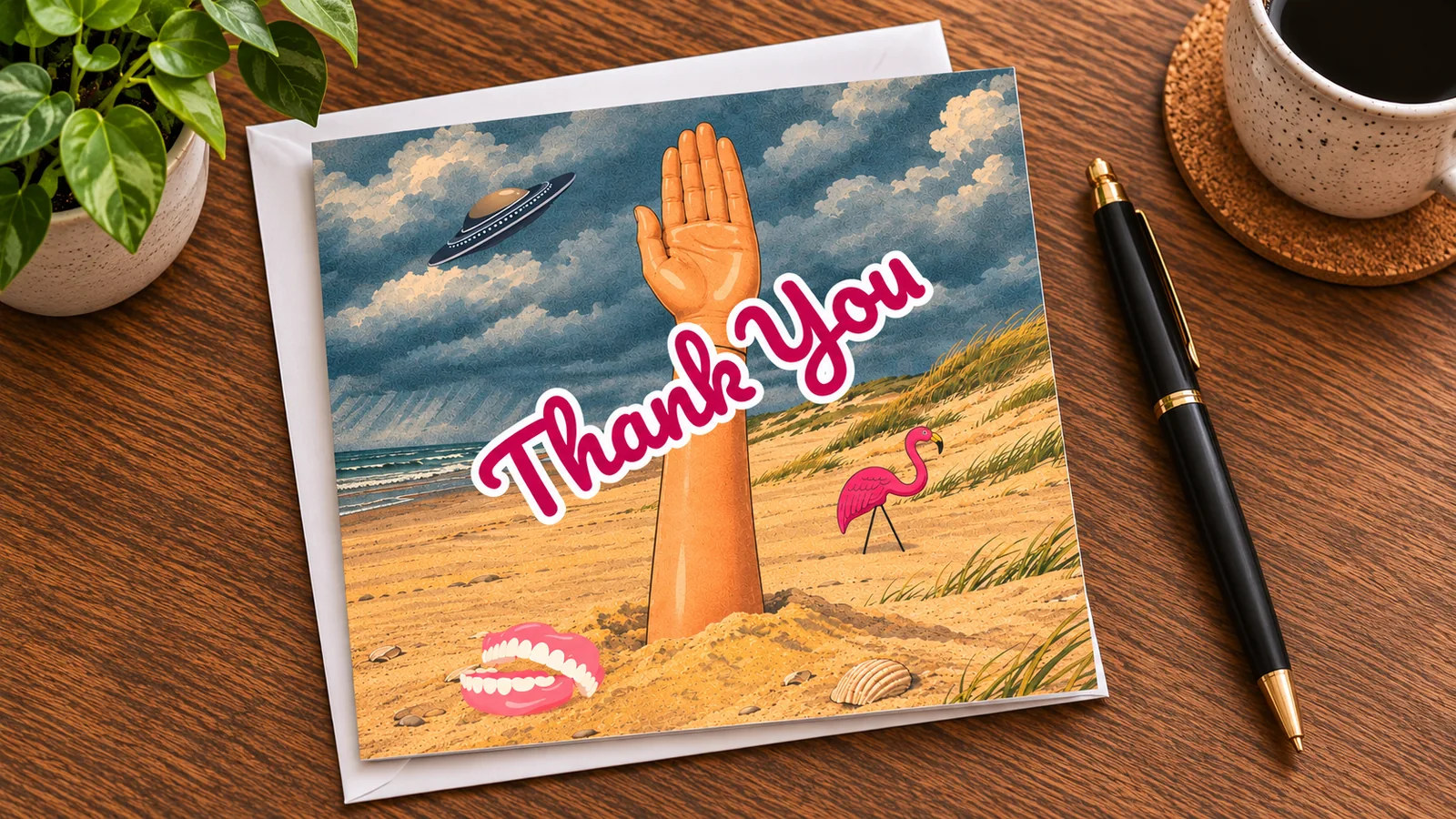
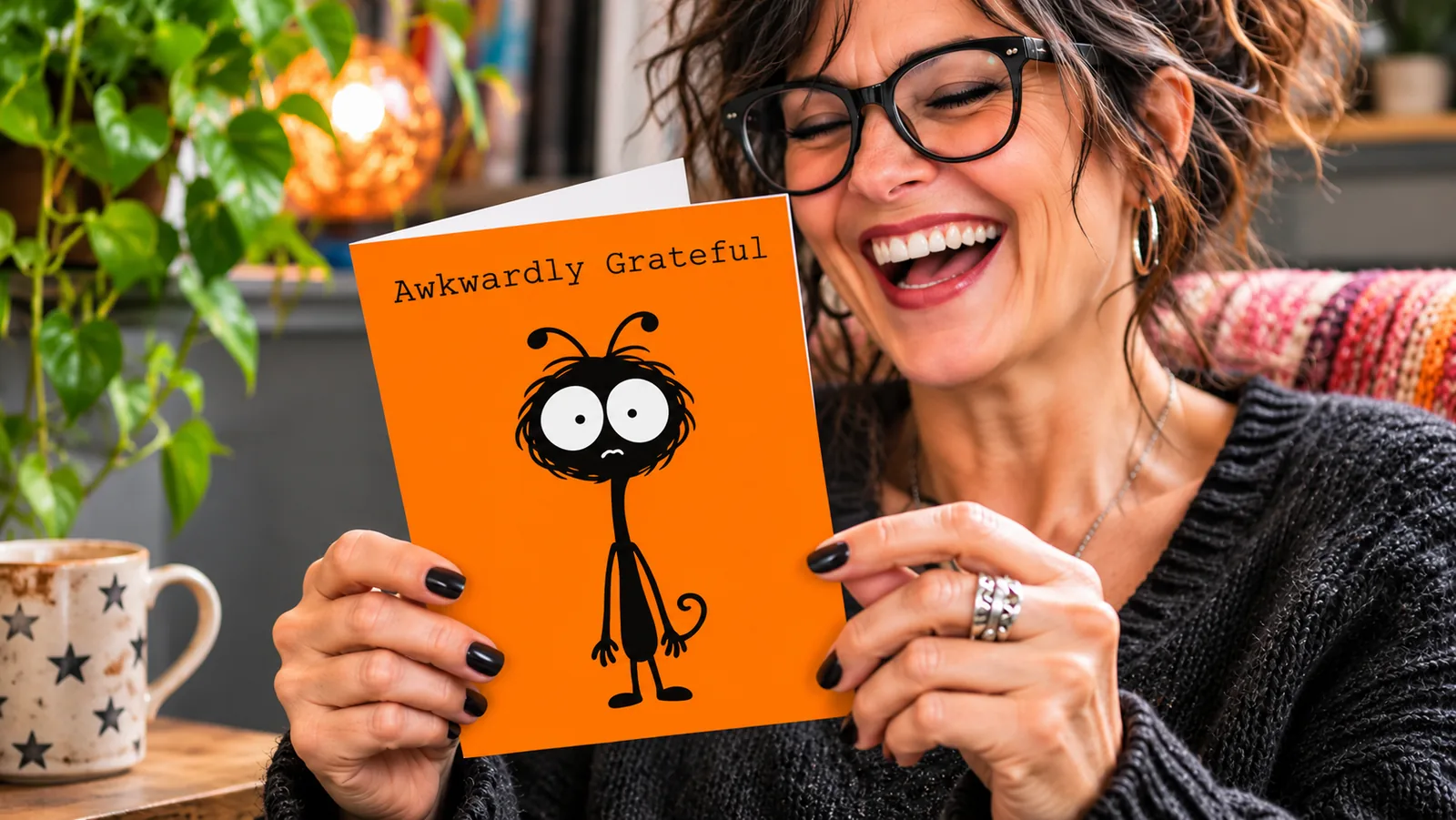
Sincerity and humour are not in opposition. For the right relationship, a best friend, a sibling, a colleague who shares your sense of the absurd, a funny thank you card can communicate genuine warmth more effectively than a formal message ever could. The humour signals that you know them well enough to make them laugh, which is itself a form of intimacy.
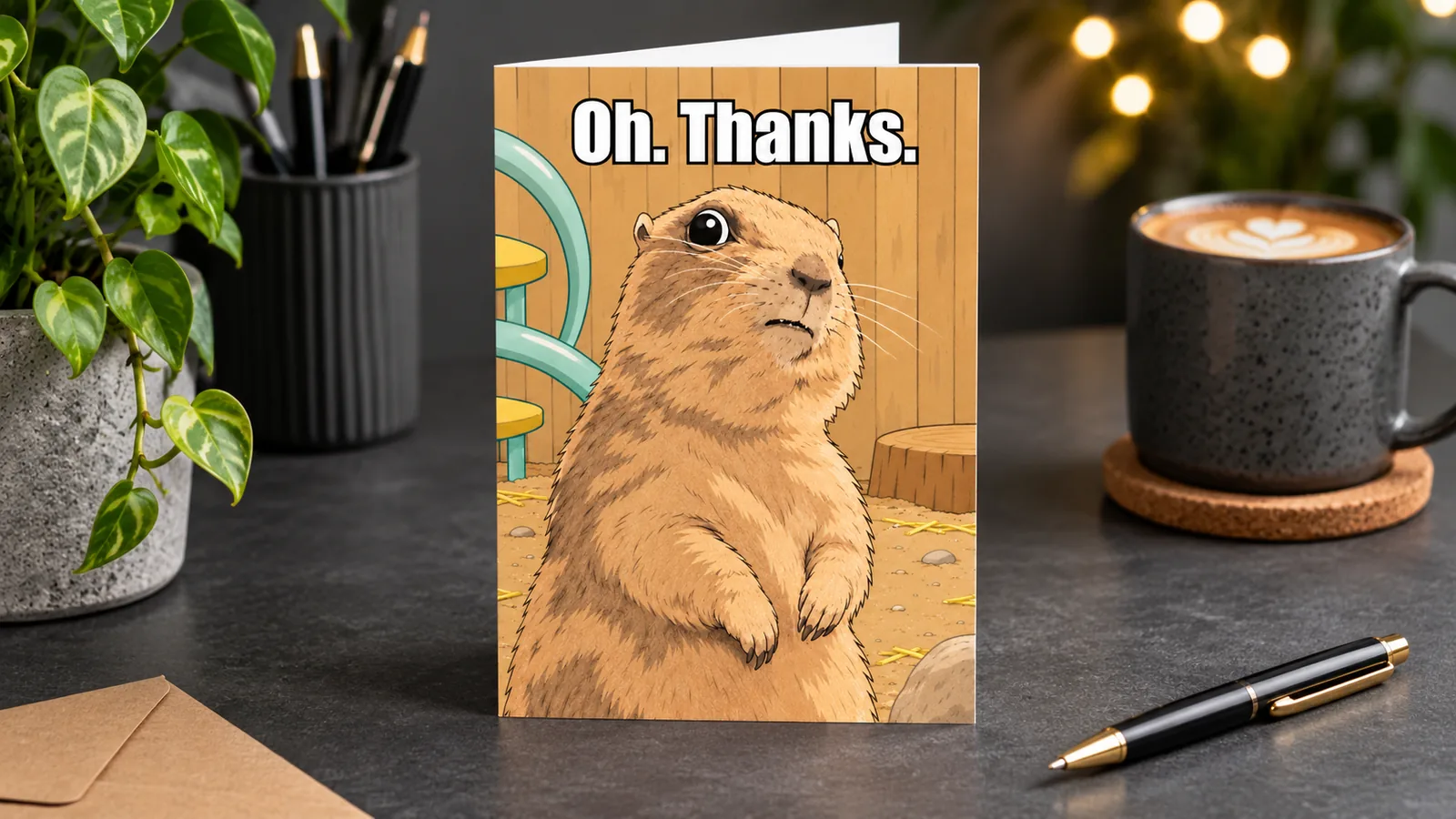
Platforms like Make It Weird Studio take this a step further, letting you combine odd characters, ridiculous objects and your own words to build something that is completely unique to the person and the moment. The result is wonderfully weird greeting cards with unexpected characters, colourful artwork and your own words, with total creative control, building your card from scratch with fun and quirky elements, rather than pre-made templates. A funny thank you card built this way carries a double message: 'I am grateful, and I know you well enough to make you smile.'
Pro tip: When writing a funny thank you card, always include a genuine line of thanks inside alongside the humour. The joke opens the card; the sincerity is what they remember.
The Gratitude Science You Should Know About
Expressing Gratitude Helps the Sender Too
Sending personalised thank you cards is not purely altruistic. Research published in the International Journal of Applied Positive Psychology indicates that expressed gratitude interventions have value in improving psychological wellbeing. Of five positive psychology interventions studied, the expressed gratitude condition had the largest positive effect on happiness relative to the control group. Write more cards and you will likely feel better yourself, a genuinely low-effort wellbeing habit.
When we feel grateful, our brains experience a surge of activity in the regions associated with moral judgement, decision-making, and the processing of sensory information. This neurological response triggers the release of feel-good neurotransmitters like dopamine and serotonin, which can boost our mood, reduce stress, and even improve our overall well-being. The act of sitting down to write a thank you card is, in a small but measurable way, good for you.
Recipients Feel More Than Senders Realise
After years of sending cards, I have come to believe that most people dramatically underestimate how much a card means to the person who receives it. Research shows that people expressing gratitude underestimated how pleasantly surprised recipients would be to receive a handwritten 'thank you' and how positive the expression of gratitude made recipients feel. On the flip side, people who wrote thank-you letters overestimated the potential awkwardness that someone receiving a heartfelt thank-you note would experience.
74 per cent of recipients say they feel more valued when receiving a handwritten note compared to a generic email or text. If you have been holding off on sending a card because you worried it would seem 'too much', the data says you have it exactly the wrong way round. Send the card.
Timing, Tone, and Common Mistakes
When to Send
Proper thank you card etiquette dictates that a handwritten note should ideally be sent within two to three weeks of receiving a gift or attending an event. While sooner is always better to ensure your gratitude feels prompt, a sincere, well-crafted message sent later is always preferred over sending no acknowledgement at all.
For professional situations, the window is tighter. Send your thank you card within 24 hours of a job interview. Job seekers who sent handwritten thank-you notes after interviews were 2.3 times more likely to be recalled well. Even candidates whose interviews went poorly were recalled more favourably when they sent a handwritten note. Those are significant odds for the price of a stamp.
Mistakes That Undermine a Good Card
Waiting so long that the occasion feels stale, aim for within a week for most personal occasions.
Writing something generic that could have been sent to anyone.
Failing to name the specific thing you are thanking them for.
Sending a text instead and telling yourself it is 'the same thing.'
Overthinking the wording until inertia wins and you send nothing.
Pro tip: Keep a small stock of personalised blank cards at home. When the urge to thank someone strikes, the barrier to acting on it is much lower if the card is already in your hand.
The UK Greeting Card Market: Physical Cards Are Not Going Anywhere
There is a persistent assumption that the digital age is quietly killing the greeting card. The market data tells a different story. The UK greeting cards market generated USD 1,823.3 million in 2025 and is projected to reach USD 2,050.9 million by 2033, reflecting a 1.5 per cent CAGR over that period, according to Grand View Research's UK greeting cards outlook.
The UK addressable market for celebration occasions is estimated to be worth approximately £14.9 billion. This includes the greeting cards market at £1.6 billion. Brits are still buying, posting, and keeping physical cards in remarkable numbers, and the category shows no sign of collapse. What is changing is the expectation of personalisation. Studies in emotional communication and consumer psychology, including insights discussed by Psychology Today, show that personalised messages significantly strengthen emotional memory and attachment. People want cards that feel made for them, which is exactly what personalised thank you cards deliver.
Frequently Asked Questions
What should I actually write in a personalised thank you card?
Name the specific thing you are grateful for, describe in one sentence what it meant to you, and close warmly. Artful Pursuits' guide to thank you notes notes that the perfect thank you card often consists of only four sentences but has a really big impact. Keep it brief, keep it specific, and write like you speak rather than trying to be formal.
How long do I have to send a thank you card?
One week is the outer limit most etiquette guides agree on, but 24 hours is genuinely better, while the gift and the moment are still fresh in your mind. For weddings and large events, two to three weeks is acceptable. If you have missed the window, send it anyway, a late card lands warmer than no card.
Are funny thank you cards appropriate, or do they seem insincere?
A funny thank you card is entirely appropriate when it matches the relationship. The key is to include a genuine line of thanks alongside the humour. Wit signals that you know someone well, which is itself a compliment. Services like Make It Weird Studio let you create genuinely personalised funny cards that feel crafted rather than off-the-shelf, which strengthens rather than undermines the sentiment.
Is a handwritten card really better than a well-crafted text?
Science has shown that receiving a handwritten note or card has a far greater emotional impact and makes people feel far more special and cared about than receiving emails or texts. A text is not worthless, but physical cards are processed differently by the brain, kept for far longer, and rated consistently higher for sincerity. For moments that genuinely matter, the card wins.
Do people really keep physical thank you cards?
Yes, in significant numbers. 86 per cent of respondents said they kept at least one hand-written note for longer than six months; only 12 per cent retained a digital greeting card beyond three days. Physical cards become part of people's lives in a way that digital messages simply do not.
Sources
Handwritten Thank-You Notes Have Surprising Consequences, Psychology Today. Research on the underestimated emotional impact of gratitude notes. https://www.psychologytoday.com/us/blog/the-athletes-way/201808/handwritten-thank-you-notes-have-surprising-consequences
Science Shows Greeting Cards Are Good for You, Thinking of You Week / Mindlab / Royal Mail. Brain activity study comparing cards and electronic messages. https://www.thinkingofyouweek.cards/create-a-wave-of-love-caring-and-happiness/
Handwritten Notes Statistics 2024, WebinarCare. Survey data on attitudes towards handwritten notes. https://webinarcare.com/best-handwritten-notes-software/handwritten-notes-statistics/
The Science Behind Handwriting Psychology and Why Physical Cards Still Outperform Digital Messages, TodaysTopQuestions. fMRI evidence and behavioural data on handwritten communication. https://www.todaystopquestions.com/the-science-behind-handwriting-psychology-and-why-physical-cards-still-outperform-digital-messages/
Handwritten Signature Direct Mail: Response Rate Studies, Stylograph.ai. Consumer sentiment and response rate data. https://www.stylograph.ai/blog/does-handwritten-mail-work-data-response-rates-roi
A Fifth of Brits Keep Every Card They've Ever Received, National World. Poll of 2,000 UK adults on greeting card preferences. https://www.portsmouth.co.uk/read-this/a-fifth-of-brits-keep-every-card-theyve-ever-received-4760858
The Effect of Expressed Gratitude Interventions on Psychological Wellbeing: A Meta-Analysis, International Journal of Applied Positive Psychology (Kirca, Malouff & Meynadier, 2023). Peer-reviewed meta-analysis of gratitude research. https://link.springer.com/article/10.1007/s41042-023-00086-6
The Effects of Gratitude Interventions: A Systematic Review and Meta-Analysis, PubMed / Einstein (Sao Paulo), 2023. 64 randomised clinical trials reviewed. The meta-analysis demonstrated
Personalised Handmade Cards: Why Words, Not Just Design, Matter, Heart in Creation. Consumer psychology of personalised gifting. https://www.heartincreation.com/personalised-handmade-cards-words-matter/
UK Greeting Cards Market Size & Outlook, 2026-2033, Grand View Research. Market revenue and growth projections. https://www.grandviewresearch.com/horizon/outlook/greeting-cards-market/uk
Bulk Greeting Cards UK: A Buyer's Guide for 2026, FiraCard. UK market size data citing Grand View Research and Statista. https://firacard.com/blog/bulk-greeting-cards-uk/
Card Factory Investor Markets Page, Card Factory. UK greeting cards and celebration occasions market value. https://www.cardfactoryinvestors.com/our-company/our-markets/
Thank You Card Etiquette and Time Frames, 4over4. Timing guidelines for every occasion. https://www.4over4.com/content-hub/stories/when-to-send-thank-you-cards-time-frames-etiquette-amp-more
What to Write in a Thank You Card: 70 Messages by Occasion, Beyond Memories. Practical guidance and thank you card structure. https://beyond-memories.com/blogs/beyond-memories/what-to-write-in-a-thank-you-card
Thank You Note Etiquette + DIY Marbled Cards, Elfster. Timing rules and writing advice. Thank You Note Etiquette: 9 Timeless Tips, Lisa Grotts. Guidance on timing (send within 48 hours ideally) and writing advice for handwritten thank you notes. https://lisagrotts.com/thank-you-note-etiquette-9-timeless-tips/
Thank You Card Wording: What to Write in a Thank You Card, Evite. Message examples and personalisation guidance. https://www.evite.com/blog/etiquette/what-to-write-in-a-thank-you-card-14-simple-thank-you-card-messages/
How To Write the Perfect Thank You Note, Artful Pursuits. Card structure and etiquette. https://artfulpursuits.com/how-to-write-the-perfect-thank-you-note/
The Essential Guide to Thank You Card Etiquette, MeLooVely. Timing, tone, and tradition. https://meloovely.com/blogs/journal/the-essential-guide-to-thank-you-card-etiquette-timing-tone-and-tradition
Make It Weird Studio, Card creator platform. https://makeitweirdstudio.com